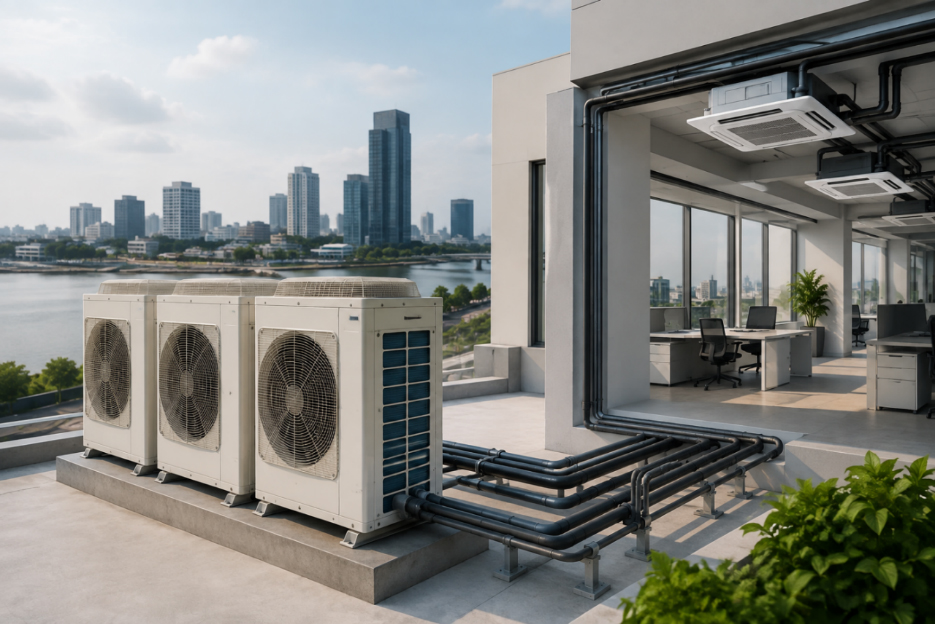
Cooling a modern commercial building rarely comes down to one number. Offices, hotels, hospitals, retail spaces, and other large facilities usually have several zones with genuinely different cooling needs, room to room and floor to floor, and a single conventional AC unit often can't give a building that kind of control.
A VRF System in Port Harcourt addresses that directly, VRF stands for Variable Refrigerant Flow: one outdoor system serves multiple indoor units, and refrigerant flow adjusts to whatever each zone actually demands at a given moment. At Pygar Group, we start by understanding a building's cooling requirements, then match a solution to its size, use, and operating conditions.
What Is a VRF System?
A VRF system conditions, and in some configurations heats, several areas of a building at the same time. It doesn't run every indoor unit at identical capacity. Instead, refrigerant flow shifts to match demand room by room; a busy conference room might draw heavily on the system while an empty office two doors down barely uses it at all.
Top Benefits of VRF Systems
Energy efficiency is usually the first reason a building looks at VRF. Refrigerant flow tracks actual demand rather than running every indoor unit flat out, so the system isn't burning electricity on cooling nobody's using. Over the many hours a day most commercial buildings run air conditioning, that difference shows up directly in the utility bill.
Room-level control follows the same logic. A server room, an office, a meeting room, and a reception area don't need identical temperatures. Zoned control means each indoor unit can be adjusted on its own, so one department can run its space cooler without dragging the temperature down for everyone else in the building.
Installation flexibility is another factor worth weighing. Several indoor units can connect to one outdoor system, so the layout suits offices, hotels, hospitals, and any property split into multiple independent spaces, and expanding or reconfiguring cooling later is generally more straightforward than with a conventional setup. Because the outdoor equipment stays relatively compact even as more indoor units are added, VRF also tends to fit buildings where plant room space is tight to begin with.
Comfort improves for a similar reason. Refrigerant flow adjusts continuously instead of cycling a compressor on and off at full capacity, so indoor temperatures hold steadier, something that matters in offices, hotels, healthcare facilities, and retail spaces where people are around all day. Compressor noise is less of an issue too. Most VRF equipment runs quieter than the larger conventional systems it tends to replace.
Centralised controls round out the list. Building operators can monitor and adjust indoor units from a single interface, catch problems before they turn into bigger ones, and schedule maintenance around what the system is actually reporting rather than a fixed calendar.
Where Can VRF Systems Be Used?
VRF fits a wide range of property types:
- Corporate offices
- Hotels and guest houses
- Hospitals and healthcare facilities
- Shopping centres and retail outlets
- Educational buildings
- Restaurants
- Mixed-use commercial properties
For buildings in Port Harcourt, choosing the right system means weighing building orientation, occupancy, heat load, operating hours, and available installation space.
Why Professional VRF Installation Matters
A VRF system's performance comes down to design, installation, and commissioning as much as the equipment itself. Refrigerant piping, indoor unit placement, outdoor unit selection, and control settings all have to be planned properly, or the system underperforms no matter how good the units are on paper.
At Pygar Group, we start by understanding the building and its cooling requirements, then design a system built around comfort, efficiency, and reliable day-to-day operation.
VRF Systems vs Conventional Air Conditioning
Conventional air conditioning still makes sense for smaller or simpler applications. Larger buildings tend to get more out of VRF, mainly because independent zone control cuts down on unnecessary cooling and gives facility managers finer control over temperature building-wide. Even so, the right choice always comes back to the building itself, and a proper cooling load assessment should happen before any equipment gets selected.
Plan Your VRF Installation With Pygar Group
A well-designed VRF system offers efficient operation, room-by-room control, and practical zoning for buildings whose cooling needs vary a lot from space to space. That makes it a solid alternative to conventional air conditioning for many commercial properties. If you're planning a new installation or upgrading an existing one, our VRF specialists can assess your building and help you choose a solution built for reliable performance in Port Harcourt and across Lagos, Nigeria.
Speak with our team about your building and cooling requirements, or let us help you plan a VRF air conditioning solution that balances comfort, efficiency, and dependable operation.
Frequently Asked Questions
What is a VRF system used for?
Cooling, and in some systems heating, for multiple rooms or zones at once. It's most common in commercial buildings and larger residential properties.
Is VRF suitable for commercial buildings?
Generally, yes. Offices, hotels, hospitals, retail spaces, and similar properties that need independent temperature control across several areas are a good match.
Does a VRF system help reduce electricity consumption?
It can. Refrigerant flow adjusts to the cooling demand of individual zones instead of running everything at full capacity, though actual savings depend on system design, usage patterns, maintenance, and operating conditions.
How should I choose a VRF system for my building?
Start with the basics: cooling load, room count, occupancy, operating hours, available installation space, and where the building is headed in the next few years. Professional design and installation take it from there.