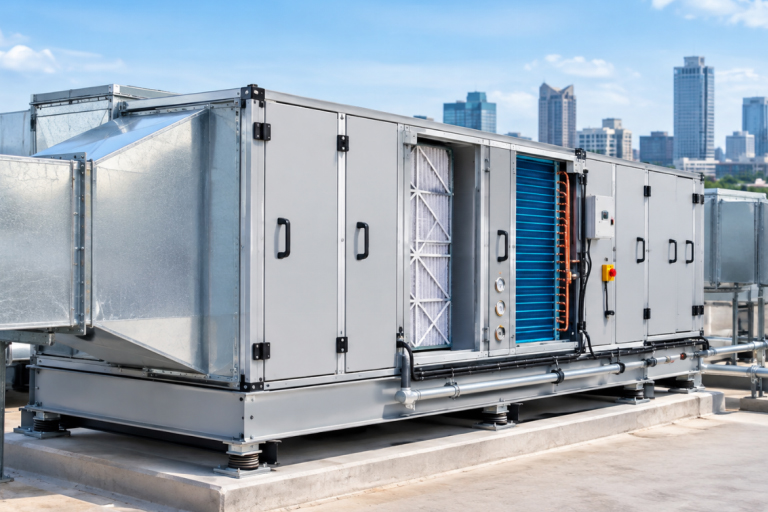
Being an office owner, hotelier, hospital administrator, or a shopping mall manager, making the environment inside these structures comfortable to live and work in is one of your key responsibilities. Both the staff and the customers will complain about stuffiness, stale air, and unequal temperatures quite soon. The equipment that does all this work for you, being the heart of any system, is called an air handling unit, or AHU.
The AHU is an essential element of many HVAC systems, performing the functions of air conditioning and distribution. The choice of the AHU is vital for the comfort inside a building.
What Does an AHU Do?
Depending on the building and how it’s used, an AHU can:
- filter the air and, in some cases, sanitise it
- cool or heat it
- control humidity
- mix fresh outside air with air returning from the building, then circulate it
In Nigeria, cooling and humidity control do most of the work. Heating is rarely the priority.
Each unit is sized for the space it serves, based on how many people use that space and how much conditioning and airflow it needs.
The Main Components of an AHU
Knowing what’s inside the unit makes it easier to run and maintain.
Air filters trap dust and other particles. Over time they clog and restrict airflow, so they need cleaning or replacing on a schedule. Dust and the harmattan season can make that schedule tighter in many Nigerian cities.
Cooling and heating coils change the temperature of the air. Cooling coils take heat out of it; heating coils add heat.
Fans move air through the unit and out into the ductwork.
Dampers regulate the amount of air flow into the AHU as well as the mixture ratio between outside air and return air.
How Does an AHU Work?
The AHU takes in the air that comes back from the building and mixes it with outside air. This air is filtered to take out the particles and heated or cooled depending on the coils. Then the fans move the conditioned air to the room via the ducts.
The AHU also regulates the return and exhaust air. In other words, this equipment manages the air coming in and out of the room, making it possible to maintain stable conditions.
Why Businesses Use Centralised AHUs
Trying to manage temperature, ventilation and air quality in a large building with lots of separate units quickly gets messy. A centralised AHU system brings it all under one roof. When it’s well designed and installed, one system can cool and ventilate different zones of the building, manage air quality to suit what each zone needs and keep the whole thing coordinated.
How to Choose the Right AHU
There’s no off-the-shelf answer. An AHU has to match the building it serves, so the starting point is a proper look at how that building is used. The key factors are its size, how many people occupy it and its operating hours.
Sizing matters in both directions. Too small, and the unit can’t keep up with demand. Too large, and it uses more energy than it should. In Nigeria, it’s also worth thinking about power: many buildings run on generators for part of the day, so the unit’s power demand needs to fit your supply.
Don’t forget access. Technicians need enough room to reach the unit for maintenance and repairs, and an AHU that’s hard to get to tends to get neglected.
Pygar Group helps clients work out their HVAC requirements and find solutions that fit them. For more on the options available, see our page on air handling units (AHUs) in Nigeria.
AHU Maintenance and Troubleshooting
Regular maintenance cuts the risk of sudden breakdowns and keeps the AHU performing well. A typical preventive maintenance visit covers:
- replacing filters
- inspecting belts and fans
- checking cooling coils
- cleaning drain pans
- inspecting and testing controls
Routine inspections also catch early warning signs, such as weak airflow or controls that don’t respond properly. Dealing with those early stops them turning into bigger problems for the rest of the HVAC system.
Where AHUs Are Used
You’ll find AHUs in offices, schools, hospitals, hotels, shopping malls, factories and other commercial and industrial buildings. Anywhere with lots of people, lots of rooms or strict air-quality needs is a good fit.
In a growing city like Abuja, where commercial and residential buildings need to stay comfortable without running up huge energy bills, a well-designed HVAC system in Abuja often has an AHU at its core.
Planning an AHU Project?
Because the AHU filters, ventilates and conditions the air for the whole building, choosing the right one matters. If you’re planning a new installation or replacing an old unit, talk to Pygar Group. We’ll go through your requirements and how the AHU should fit into your wider HVAC system.
Frequently Asked Questions
What does an air handling unit do?
It conditions air and moves it around a building. Inside are components that filter the air, adjust its temperature and humidity, and push it through ductwork to the rooms.
Where are air handling units used?
Mostly in large buildings: offices, hospitals, hotels, shopping malls, schools, factories and other commercial or industrial facilities.
How often should an air handling unit be serviced?
It depends on how heavily the unit is used and where it’s located, and dusty sites need more frequent checks. Whatever the schedule, the fans, coils and filters should be checked at every preventive maintenance visit.
How do I choose the right air handling unit for my building?
Look at the building’s size and purpose, how many people use it, their cooling and ventilation needs, and its operating hours. Together, these decide the capacity and layout the AHU needs.