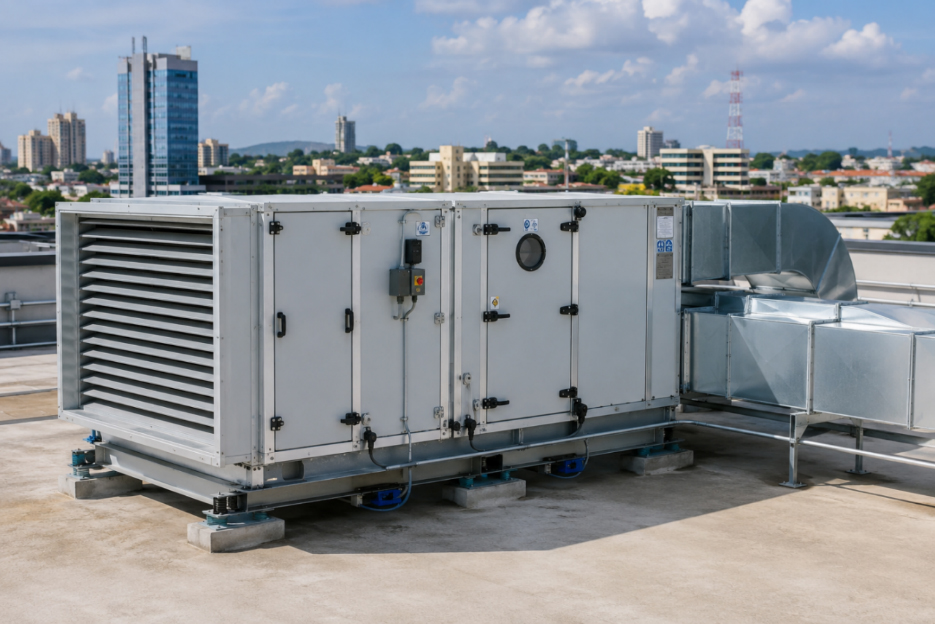
Large facilities - offices, hospitals, hotels, shopping centres, industrial sites — rarely have one air quality problem. They have several, spread across different zones, each with its own temperature, humidity, and ventilation needs. An Air Handling Unit (AHU) in Port Harcourt is built to manage exactly that kind of complexity.
At Pygar Group, we assess the cooling and ventilation needs of each commercial facility and recommend solutions matched to the building's size, operating pattern, and use.
What Is an Air Handling Unit?
An air handling unit, or AHU, is a mechanical system that conditions and moves air throughout a building. Depending on the application, it can filter, cool, heat, dehumidify, and distribute air through a network of ducts.
A typical AHU includes some combination of the following:
- Air filters to remove dust and airborne particles
- Cooling coils to lower air temperature
- Fans to circulate conditioned air through the building
- Dampers to control airflow
- Heating or reheating components
- Humidity control
- Fresh-air and return-air sections
Selecting the right AHU for a commercial facility matters because the system has to handle varying occupancy and shifting demand inside an enclosed space, not a fixed load.
Why Commercial Buildings Need AHU Systems
Buildings with multiple floors, rooms, or operational zones are difficult to condition evenly with standalone units. An AHU, centrally located and properly ducted, manages that complexity from one point instead of many, which tends to mean fewer inconsistencies in how a building actually performs day to day.
That centralization pays off in a few concrete ways. Indoor air quality improves when filters, controlled fresh-air intake, and properly designed ventilation work together to reduce airborne pollutants. Temperature control gets more consistent, since a well-designed ducted system limits the overshoot that standalone units are prone to. Ventilation itself is more reliable — active air movement and a steady fresh-air supply are non-negotiable in any occupied commercial space, and an AHU is built to deliver both.
Humidity management is worth calling out on its own, particularly in Port Harcourt's climate. Uncontrolled humidity affects comfort, but it also affects materials and equipment inside the building; a correctly selected system keeps humidity within a range that protects both.
Maintenance is simpler, too, in the sense that it's centralized rather than eliminated. One system means filters, coils, belts, fans, and controls can be inspected and serviced from a single point, which makes it easier to catch a failing component before it becomes a bigger problem.
Considerations When Selecting an AHU for a Commercial Space
The unit itself is only part of the decision. Building-specific factors determine what actually fits:
- Size and configuration of the building
- Capacity and density of occupants
- Required fresh air volume
- Cooling load
- Required humidity level
- Operating hours
- Space needed for filtration
- Size and configuration of the plant room
- Ductwork design
- Estimated energy consumption
- Room for future growth
A proper HVAC design and installation process makes sure the AHU is sized correctly and integrates with the building's other mechanical services, rather than working around them.
Where AHUs Are Used
AHUs show up across a wide range of commercial buildings, including:
- Corporate offices
- Hotels and other hospitality venues
- Hospitals and health facilities
- Retail and commercial buildings
- Schools and universities
- Industrial and manufacturing facilities
- Warehouses and other large commercial spaces
In Port Harcourt's humid coastal conditions, equipment selection and upkeep carry extra weight. Good filtration, proper drainage, well-maintained coils, and sound ventilation design are what keep performance from slipping over time.
Keeping an AHU Performing
Even a well-designed system needs upkeep. A poorly maintained AHU uses more energy, moves less air, and leaves building occupants less comfortable - usually well before it fails outright.
A reasonable maintenance routine covers filter replacement, coil cleaning, checks on fans and drive belts, water leakage inspection, electrical system checks, and testing of controls and dampers. Unusual noise, weak airflow, water leaks, or a jump in energy costs are all early signs that a system needs attention before something breaks.
How Pygar Group Can Help
We design AHU solutions around the practical requirements of each facility, tailoring the system to how the building actually operates rather than applying a standard template. Whether you're planning a new installation or replacing an aging system, we can help determine what your project needs and size it accordingly, flexible enough to integrate with new or existing infrastructure.
For businesses in Port Harcourt, a correctly designed AHU delivers reliable comfort and air quality control, but only when sizing, installation, commissioning, and maintenance are handled to match the building's specific requirements. Visit Pygar Group to learn more about our HVAC services, or place your order with us to get started on your AHU project.
Frequently Asked Questions
What does an AHU do in a commercial setting?
It conditions and distributes air, filtering, cooling, supplying, circulating, and dehumidifying as needed through the building's ductwork.
Is an AHU right for a large office?
Yes, AHUs suit buildings where centralized air circulation and ventilation are needed across multiple connected or large occupied zones.
How often is AHU maintenance needed?
That depends on usage, environmental conditions, and manufacturer recommendations. Filters and other key components should be checked on a regular schedule regardless.
Can AHUs improve indoor air quality?
Yes, when the system is well designed and properly maintained - good filtration, a steady fresh-air supply, and consistent air circulation all contribute to that.