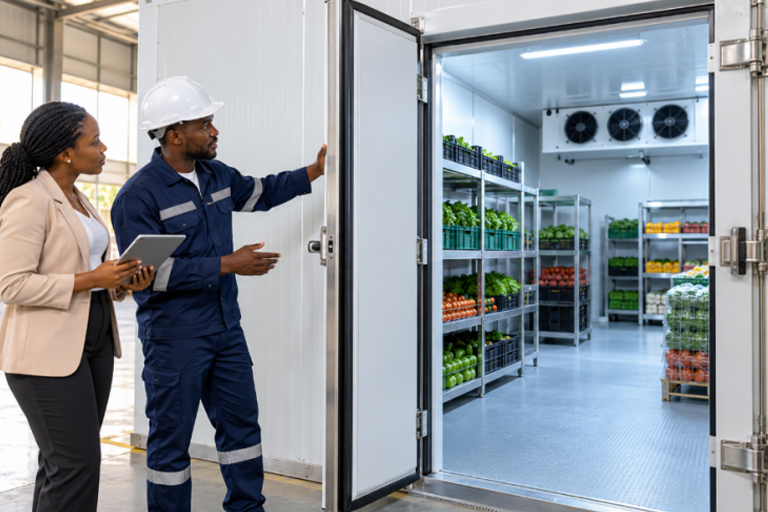
A restaurant in Wuse and a distributor in Idu have very different needs when it comes to their cold rooms. The restaurant is only storing what they expect to sell that day, whereas the distributor stores large pallets of frozen chicken. A restaurant may need to open their cold room many times during service, whereas the distributor only needs to load their cold room a few times a week. A cold room that is suitable for the restaurant would not be suitable for the distributor.
Purchasing a cold room is not simply choosing a refrigeration unit from a catalogue. The unit needs to be designed to complement its contents. The unit must also be able to support long term use and be built to keep heat out. The supplier can help shape all three of these.
Start With Your Actual Storage Requirements
There are various conditions for storage based on the type of produce. For example, fruit and vegetables need to be stored at different conditions from meat and fish. Some produce can be damaged if stored at the wrong conditions. Certain medicines must be stored at specified conditions.
Furthermore, consider the volume and turnover of the goods you are storing. Goods that arrive warm add a lot of extra heat to the cold room and the condensing unit needs to be placed in a well-ventilated location. Walk-in cold rooms in Abuja come in different sizes, from small kitchen units to larger modular stores.
Change in scale alters the nature of engineering. A restaurant may need a single condensing unit and evaporator. In contrast, the commercial cold storage systems in Abuja that food distributors use may require several rooms at various temperatures, an anteroom, and multiple refrigeration circuits. One fault should not put the entire stock at risk.
Check the Supplier's Technical Capabilities
A competent supplier should calculate the refrigeration load before offering a solution. Such a supplier takes into account dimensions of the room, type and quantity of product, loading temperature, door openings, insulation, and daily movement. The ambient condition is also considered. The afternoons in the hot season in Abuja can go as high as 35 °C and may cause challenges to a milder climate conditioned condenser.
Be cautious of suppliers that base their quotes solely on the size of the room being conditioned. Two rooms of the same size and capacity may have very different capacities, especially if one room stores pre-chilled drinks and the other fresh meat. The supplier should state their assumptions clearly, and also undertake a site visit to assess the conditions of the site, including the power and drainage. Credible cold room installation services in Abuja should begin with a site assessment.
A refrigeration equipment supplier Abuja buyers can rely on explains the reasons for its sizing, instead of simply quoting a tonnage.
Inspect the Equipment and Materials Being Supplied
Panels account for the major part of the insulation. PUF panels are popular and freezer rooms require thicker panels than chiller rooms. Ask about joint design and foam density.
The compressor, evaporator and condenser should be paired with one another and with the calculated load. A digital controller with alarms, defrost management and temperature logging can assist in locating problems before stock is lost and gives pharmaceutical businesses the records their quality procedures may require.
Serviceability matters as much as brand. A well-known compressor helps little if parts must be imported for every fault, so ask which components of the commercial cold storage systems Abuja suppliers stock locally.
Expect doors to freeze shut on walk-in cold rooms in Abuja kitchens. With traffic flow, determine which type of door design would work best. Freezer doors will require heated frames.
Installation Quality Matters as Much as Equipment Quality
Poorly sealed seams in the panels of a cold room allow warm, moist air to enter and frost the evaporator, reducing the airflow and extending run times.
Proper cold room installation in Abuja protects electrical connections and ensures that the evaporator is not blowing air on the door, trapped drain lines (heated in a freezer) and vapour sealing.
Commissioning is the final test. Pull-down time, alarms, and other settings of the digital controller need to be tested for proper operation. Defrost timers and cycles need to be checked as well. A cold room installation in Abuja businesses accept without these tests leaves them finding problems with stock already inside.
Consider Electricity Consumption and Operating Costs
Cold rooms run 24/7. An Undersized refrigeration equipment is often undersized because the evaporator is too small. An oversized cold room is cycling too much. Humidity control is also affected by the size of the cold room. All the factors that increase the load on a cold room (e.g. thin walls and worn gaskets) also increase the electricity consumption. The cold room installation Businesses in Abuja plan carefully, with correctly sized equipment and well-sealed panels, usually costs less to run.
Some businesses go with a grid-tie system and also install a backup power source (i.e. generator and/or inverter). Ask how the equipment will react to a voltage fluctuation. It is also important to check what voltage and phase protection the equipment has. Pharmaceutical distributors may want to have a backup power source for its commercial cold storage systems in Abuja, while a drinks store may not need it.
Ask About Maintenance, Repair and Spare Parts
Preventative maintenance may include checks on door seals, alarm tests, and/or clearing clogged drains. Ask what kind of maintenance schedule the supplier recommends, and if the cold room installation in Abuja includes preventative maintenance or if it is a separate service.
A refrigeration equipment supplier Abuja customers can reach quickly is often worth more than a cheaper one with no clear support arrangement in the city.
Before Engaging a Cold Room Supplier in Abuja
There are some vital questions to ask potential cold room suppliers in Abuja. These include:
- Will you perform a site assessment before quoting?
- How will the cooling capacity of the cold room be calculated?
- What compressor, evaporator and condenser will you use and why?
- What panel thickness and density will suit this temperature?
- What will be the scope of testing and commissioning before handing over the cold room?
- What are the warranties granted and what will they not cover?
- Who provides cold room repair services Abuja-wide once the warranties lapse?
- Will you store spare parts locally?
- What will be your recommended preventive maintenance schedule?
Support Provided by the Pygar Group
Pygar Group is a Nigerian company offering a range of HVAC and refrigeration services. Its commercial refrigeration range includes chilled cold rooms, freezer rooms, blast freezers, PUF panels of different thicknesses, evaporator and condensing units, and several types of cold room door. The company states that it serves the Abuja market with delivery and installation and therefore, businesses interested in cold storage rooms in Abuja can source equipment and services from one supplier.
Its after-sales service includes a workshop for refrigeration repairs and a service van for on-site maintenance. Buyers should ask how the company arranges the cold room repair services Abuja sites will need once the warranty ends.
Making the Final Decision
A cold room is an expensive long-term investment. Judge each cold room installation Abuja suppliers propose against several criteria.. First is product fit. Does the design take into account your specific product and site requirements? Second is the use of insulation and components suitable to the storage temperature. Is the cold room properly commissioned? Finally, is the cold room supplier able to provide technicians to support you?
Price is important, but judge only after evaluating the above criteria. A refrigeration equipment supplier Abuja businesses choose on price alone may end up costing you more in lost stock and high electricity costs over the life of the cold room.
Frequently Asked Questions
How much does a cold room cost in Abuja?
The cost varies with the requirements of the cold room. It depends on the size of the room, the temperature at which it is required to store goods, the thickness of the walls, the capacity of the refrigeration equipment, the type of doors and the site conditions. The best way to compare proposals is to ask the suppliers to provide an itemized quote after a site visit.
What is the difference between a cold room and a freezer room?
A cold room stores goods at a temperature between 0 °C and + 8 °C and a freezer room stores goods at a temperature of -18 °C or lower. A freezer room needs thicker insulation and more refrigeration capacity than a cold room. A freezer room also needs heated door frames and drain lines.
Can a cold room run on a generator?
It is possible with the right generator. The supplier should be able to confirm compatibility and voltage protection on the generator for you. The generator should be sized to the starting current of the compressor, as well as the running load.
How long does the installation take?
This depends on a number of factors like how large the cold room is, how prepared the site is, and if the equipment is in stock. Get a written program from the supplier covering when they expect to deliver the cold room, when they expect to install it, and when they expect to commission it.
How often does a cold room require servicing?
Do what the supplier recommends based on how you are using the cold room. Rooms with heavy door traffic, or condensers exposed to Harmattan dust, may need more frequent coil cleaning.
Planning a commercial cold room project in Abuja? Contact Pygar Group to discuss your cold storage needs and to explore the best cold storage solutions for your business.